Penguins
Where'd You Go BernadettePenguins are the defining animals of Bee Branch’s Antarctic voyage: first an unexpected correction to her imagined wildlife, then a recurring presence in the ship’s plans and the landscape, and finally the subject of her own fieldwork. Through Bee’s account, they are at once spectacular inhabitants of the ice and ordinary, noisy animals whose behavior resists any simple picture of polar idyll.
Expectations and identification
Before the trip, Bee learns from eighth graders that Antarctica has land, unlike the Arctic as they describe it, and that there are no polar bears in Antarctica. Her imagined view from the boat had included polar bears attempting to leap between melting icebergs; instead, the southern wildlife she anticipates is penguins. She recognizes that polar bears and penguins belong to opposite ends of the earth, and makes her own prior misconception part of the account. Penguins therefore enter the story first as a correction: the voyage will not deliver the familiar, imagined pairing of animals, but an encounter with wildlife she has not yet seen.
That expectation becomes part of family conversation before the shipboard routine begins. During a meal in Elgin Branch’s office, while a countdown to the launch of Samantha 2 appears throughout the building, Bee tells her parents about the different kinds of penguins they might see. Her mother, Bernadette Fox, responds by imagining a different sort of pleasure on the trip: the family could use a table for four and occupy the spare seat with their gloves and hats, keeping the table to themselves. Bee and Elgin exchange a look at the suggestion. Penguins are already a subject of shared anticipation, but the scene also places that anticipation beside Bernadette’s wish to avoid other passengers.
Penguins as spectacle at sea
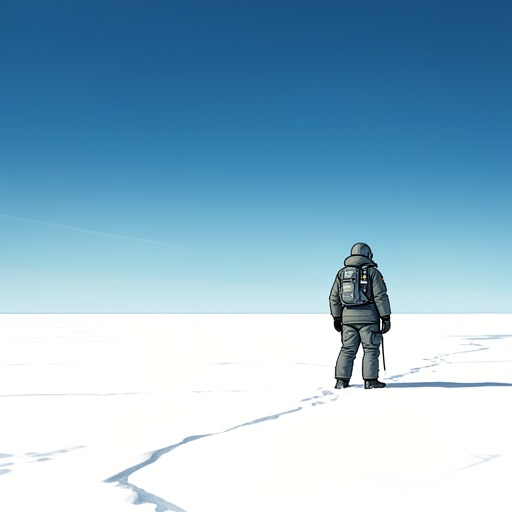
Once the voyage is underway, penguins are part of the landscape Bee tries to remember and describe. She sees an emperor penguin standing alone on an iceberg, its orange cheeks distinct against the surrounding ice. She cannot tell how it arrived there, how it will leave, or whether it wants to leave. The unanswered questions preserve the animal’s separateness: Bee can observe it, but cannot supply its history or intentions.
The sea offers a different kind of sight. Bee watches penguins hop across the dark water and propel themselves onto an iceberg, a movement she singles out as a favorite. On one occasion she sees a pod of fifty killer whales, including mothers and young, in the same stretch of ocean; the penguins’ brief leaps toward safety take place within a larger scene of animals moving through water and ice. The abundance is exhilarating but also presses on Bee: because few people get to witness it, she feels she should remember the spectacle carefully and find words adequate to it. Her account does not leave the animals as scenery, though it remains shaped by the human observer’s effort to record what she sees.
From postcard image to living colony
The narrative repeatedly complicates the beautiful image of Antarctic wildlife. During an evening recap, Bee hears about a study in which scientists count penguin chicks. The following day’s announced destination is Port Lockroy, a former British military outpost from the Second World War that has become a heritage museum, gift shop, and post office. Bee becomes intensely excited at the prospect of going ashore, initially hoping for her mother; the setting brings penguins into a human-managed landscape of souvenirs and letters as well as their habitat.
At Port Lockroy, Bee reaches the entrance ahead of the other visitors, crossing rocks where Gentoo penguins guard their nests. The building grows smaller in her view as the Zodiac approaches, and the landing requires her to scramble across the rocks before reaching the wooden ramp. Inside, she finds a gift shop filled with books, stuffed animals, postcards, and clothing decorated with penguins. There is no sign of Bernadette. The contrast is pointed but grounded in Bee’s immediate experience: the penguin is both a living animal outside the station and an image reproduced for visitors inside it.
Counting Adélie chicks
Penguins become more than a sight when Nick, a penguin counter, invites Bee to assist with research. He takes her in a Zodiac to an Adélie penguin colony and gives her a clipboard bearing a satellite map with marked boundaries. The task follows a study conducted a month earlier, when another scientist counted eggs; Bee is to determine how many have hatched into chicks. Nick initially assesses the colony as a complete breeding failure, a conclusion that shocks Bee. He asks her to observe the animals and report what she sees, then leaves her with a clicker while he visits another colony, planning to return in two hours.
Bee works across the mapped area, clicking whenever she sees a gray chick between an adult’s feet. Because the nests do not form a neat grid, she must keep track of where she has counted and avoid counting any nest twice. She repeats the count and obtains the same number. The episode gives her a defined role in an ongoing study, shifting her from passenger and spectator to participant in a methodical act of observation. The account does not give a final scientific result or explain the cause of the apparent breeding failure; what it records is the work of counting and the seriousness with which Bee approaches it.
Unidealized animal life
The colony also overturns the clean, charming image that souvenirs and travel expectations can encourage. Bee notices peach and green patches on the penguins’ chests, which she identifies as material from their feeding of chicks, and finds that they smell and make considerable noise. Their calls sometimes sound soothing, but much of the time they screech. She watches them waddle around stealing rocks from one another and fighting over them. These details make the animals vivid without making them human: feeding, nesting, and competition are visible, while the colony’s behavior is not reduced to a sentimental emblem.
Bee’s penguin observations sit beside a broader account of the Antarctic environment: icebergs, beaches, sea ice, whales, and animals seen from the ship or on shore. Her attention moves between wonder and practical detail, from an emperor penguin alone on an iceberg to the repeated clicks needed to count Adélie chicks. Penguins thus connect the voyage’s spectacular landscape with the patient work of field observation, while their presence in the gift shop shows how readily living wildlife becomes a human image. The account sustains all three views without making them identical: the animals can be beautiful to watch, difficult to count, and plainly unlike their representations on souvenirs.